eDocify platform overview
eDocify is a proprietary Bitlogika AI-powered document operations platform for companies that need one controlled way to receive, recognize, verify, approve, export, and archive business documents. It is designed as a product family rather than one generic OCR screen: accountants, verifier teams, records managers, auditors, and integration owners each get their own workspace.
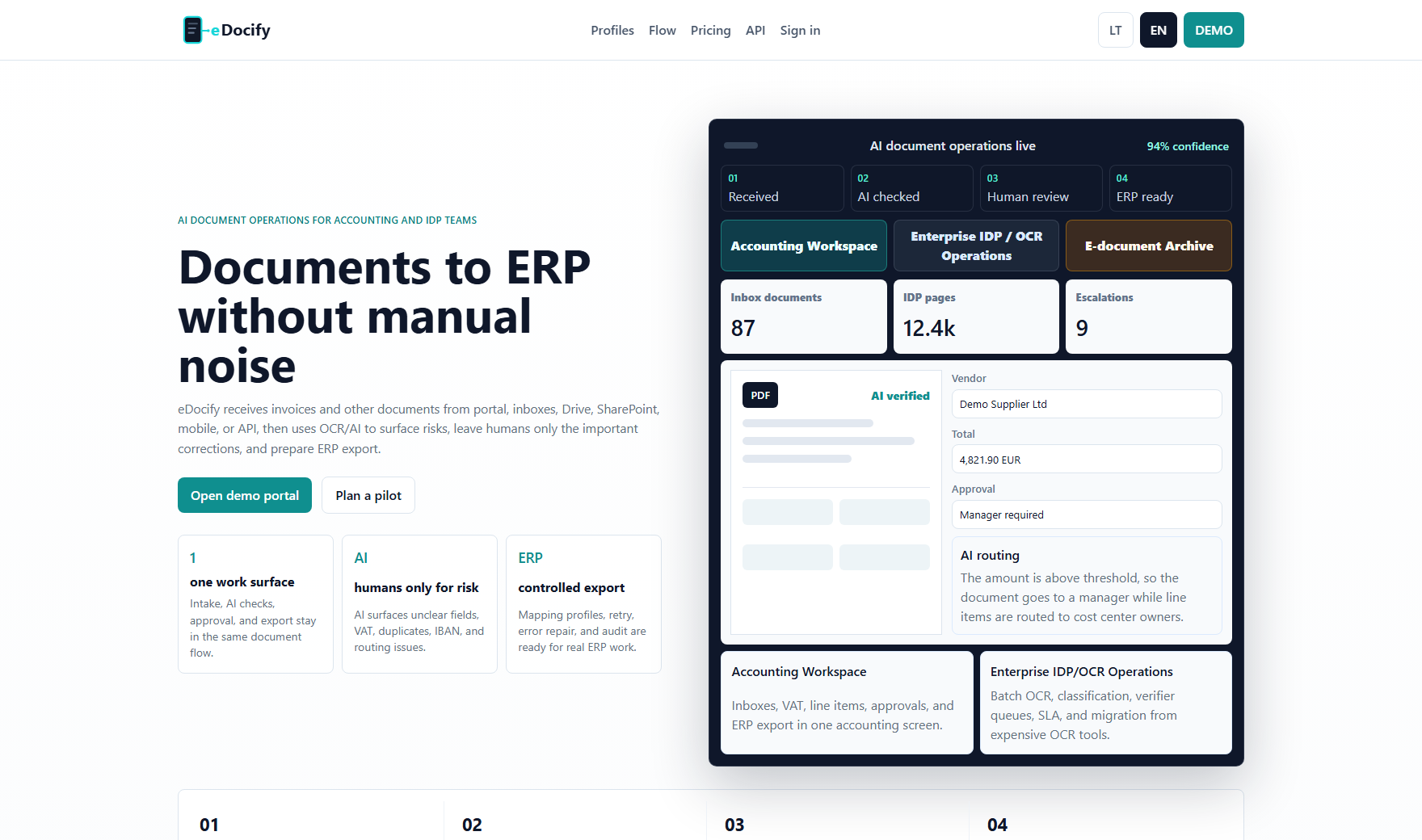
Product family
| Product | Primary users | Main outcome |
|---|---|---|
| Accounting Workspace | Accountants, AP teams, accounting service firms | Fast invoice, receipt, approval, and ERP export workflow. |
| Enterprise IDP / OCR Operations | Document factories, verifier teams, BPO operations | High-volume OCR, AI verification, quality governance, SLA control, and multi-document operations. |
| E-document Archive | Records managers, auditors, compliance teams | Searchable, retention-aware, audit-ready long-term document archive. |
Demo and documentation evidence
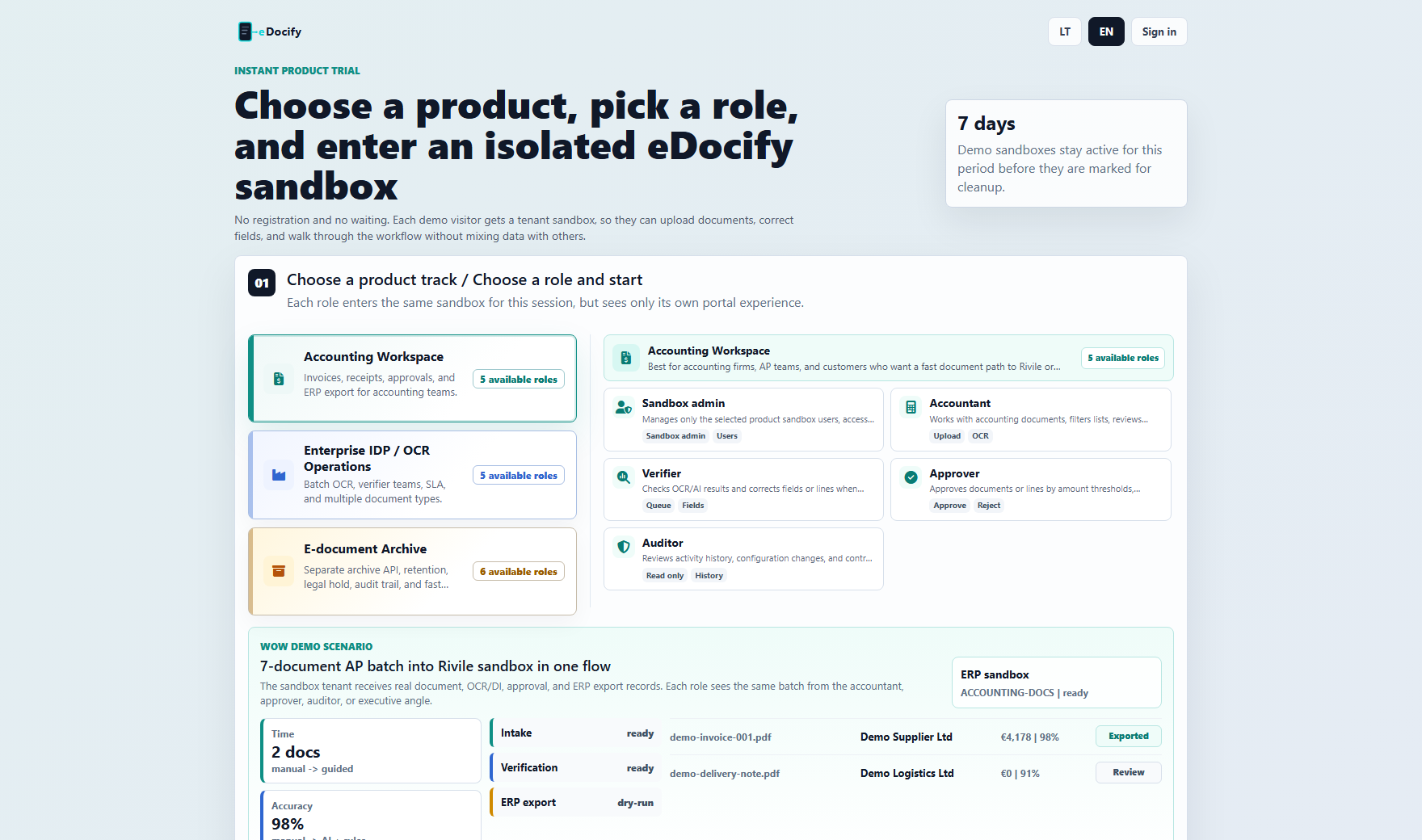
The screenshots in this documentation are not memory mockups. They are captured from the local eDocify app with English UI, product-specific demo sandbox sessions, and role-specific navigation. The generated manifest is stored at /img/edocify/role-workspaces/manifest.json and records the product, role, route, visible menu items, and detected UI errors for every screenshot.
Platform flow
flowchart LR
  A["Intake sources"] --> B["Preparation: split, merge, rotate, security checks"]
  B --> C["OCR / AI provider routing"]
  C --> D["Field processing and validation"]
  D --> E["Verification workbench"]
  E --> F["Approval workflow"]
  F --> G["ERP export or archive"]
  E --> H["AI Learning and Quality Engine"]
  H --> C
What makes the platform enterprise-ready
Role-specific workspaces. A verifier does not see the same cockpit as a system administrator. An archive viewer does not see AI Learning. A sandbox admin stays inside the selected product sandbox.
Multi-engine OCR, ML, and hybrid routing strategy. eDocify supports Azure Document Intelligence, Mistral OCR, OpenAI-style AI providers, local Tesseract, RapidOCR, local PaddleOCR, deterministic invoice rules, .NET-based machine learning/ranking components, and hybrid routes that combine cloud AI, local OCR, local LLM JSON structuring, rule validation, fallback providers, and human verification.
Quality governance and AI Learning. OCR quality is treated as a release process: golden datasets, field-level accuracy, provider bake-offs, confidence calibration, release gates, and a proprietary AI Learning engine that learns from verifier corrections.
Audit-first operations. Intake, verification, approval, export, archive, sandbox, and admin actions are designed to create traceable audit evidence.
Azure-ready, VPS-friendly. The architecture is prepared for Azure hosting, but can also run on a controlled VPS for early public demos and pilots.
Startup funding readiness
eDocify is documented as a product business, not a custom development engagement. The funding-readiness pages explain how the platform uses AI, why cloud infrastructure is required, how sensitive document data is handled, what the product roadmap looks like, and which pilot scenarios can prove customer value.
- How eDocify uses AI
- Infrastructure and cloud usage
- Security, privacy, and data handling
- Product roadmap
- Use cases and pilot scenarios
Product guides
- Accounting Workspace
- Accounting Workspace role guide
- Enterprise IDP / OCR Operations
- IDP / OCR Operations role guide
- E-document Archive
- E-document Archive role guide
Role guides
Each role has a separate user guide with product scope, visible menus, daily workflow, allowed actions, denied actions, screenshots, and a demo test path.
- System admin
- Tenant admin
- Client admin
- Integration admin
- AI learning user
- Accountant
- Verifier
- Approver
- Finance director
- Auditor
- Viewer